
Your business name is correct. Your ABN is on the page. There is a payment deadline and a familiar-looking renewal heading. That still does not tell you who sent it, whether you owe them anything, or what paying will actually buy.
Australian businesses receive genuine ASIC reminders, optional renewal-service offers and outright impersonation scams. They need different responses. The useful question is not just “does this look official?” It is “is my registration due, and have I chosen this supplier?”
Illustration only. These are not real ASIC notices or examples of a particular provider’s paperwork.
Three things that can look like the same bill
A genuine renewal: your business-name registration needs renewing with ASIC. Check the due date independently and use ASIC’s own service or a provider you have deliberately engaged.
An optional service offer: a private business offers to handle the renewal for an extra fee. Outsourcing is not automatically a scam. An unsolicited offer is not evidence that you already owe that business money.
A misleading notice or impersonation attempt: the presentation may obscure that it is an optional service, or someone may pretend to be ASIC to collect money or login details. A correct business name, logo or reference number is not proof of authenticity.
ASIC’s warning about unsolicited notices says third-party offers should clearly explain that they are independent of ASIC, distinguish their service fee from ASIC’s fee, and make clear that the offer is not a bill requiring payment. Check the whole offer, not just its heading.
Real examples you can inspect online
These examples are dated so you can see the evidence without confusing an old notice or regulatory action with a claim about every current transaction.
A real BNrenewal letter dated 24 October 2017
This historical letter directs the reader to a private BNrenewal website, then asks them to enter contact details and pay by card. The steps make payment the next action, but do not establish that ASIC sent the letter or that the recipient has already chosen this intermediary.

The lower disclaimer identifies the correspondence as not being an ASIC renewal notice. Read that qualification alongside the renewal steps above: the offer is from a private service, so the decision is whether to engage that service after independently checking the real renewal. An optional intermediary service does not by itself prove a fake registration, fraud or failure to perform.

The excerpts preserve the source image; no notice wording has been recreated. View ABF Partners’ original article and complete redacted letter. Its warning is a historical publisher account, not a court finding about every transaction or current conduct.
A published Registration Pty Ltd notice, January 2023
Small Business Answers published Angus Jones’s account of a notice from Registration Pty Ltd on 25 January 2023. It reported a $99 one-year offer, a $10 early-payment incentive and wording saying it was not a bill. The publisher hosts a redacted photograph of the historical notice as well as a separate ASIC webpage screenshot. Read the author’s account for context.

Those are historical offer amounts, not today’s ASIC fees. This is a publisher’s first-person example, not a court finding reproduced here. Its practical lesson is to look past the payment layout and ask whether you are buying an optional handling service.
ASIC’s registered-agent cancellations in 2026
ASIC says it cancelled the registered-agent status of Registration Pty Ltd and Biz Australia Pty Ltd on 5 June 2026 for breaches of its Registered Agent Terms and Conditions. ASIC identifies those entities as affiliated with reg.com.au. Read ASIC’s release 26-112MR.
On 22 July 2026, ASIC announced cancellation of Registry Australia Pty Ltd’s registered-agent status for breaches of the same terms, following an earlier suspension. It identifies the entity as affiliated with registry.com.au. Read ASIC’s release 26-163MR.
Be precise about those outcomes: cancellation of registered-agent status is not the same as a fraud conviction, deregistration of the company, or a finding that every renewal it handled failed. The linked releases establish the action ASIC actually took.
A current provider price page
On 24 October 2026, Registry Australia’s own renewal page displayed $99 for one year and $189 for three. Its one-year order summary split the $99 into a $52 service amount and a $47 government fee. Those are the provider’s published figures, not our verification of ASIC’s current fee. The example shows why comparing the total and the service component matters; charging a handling fee is not itself evidence of fraud.
Check the real renewal before paying
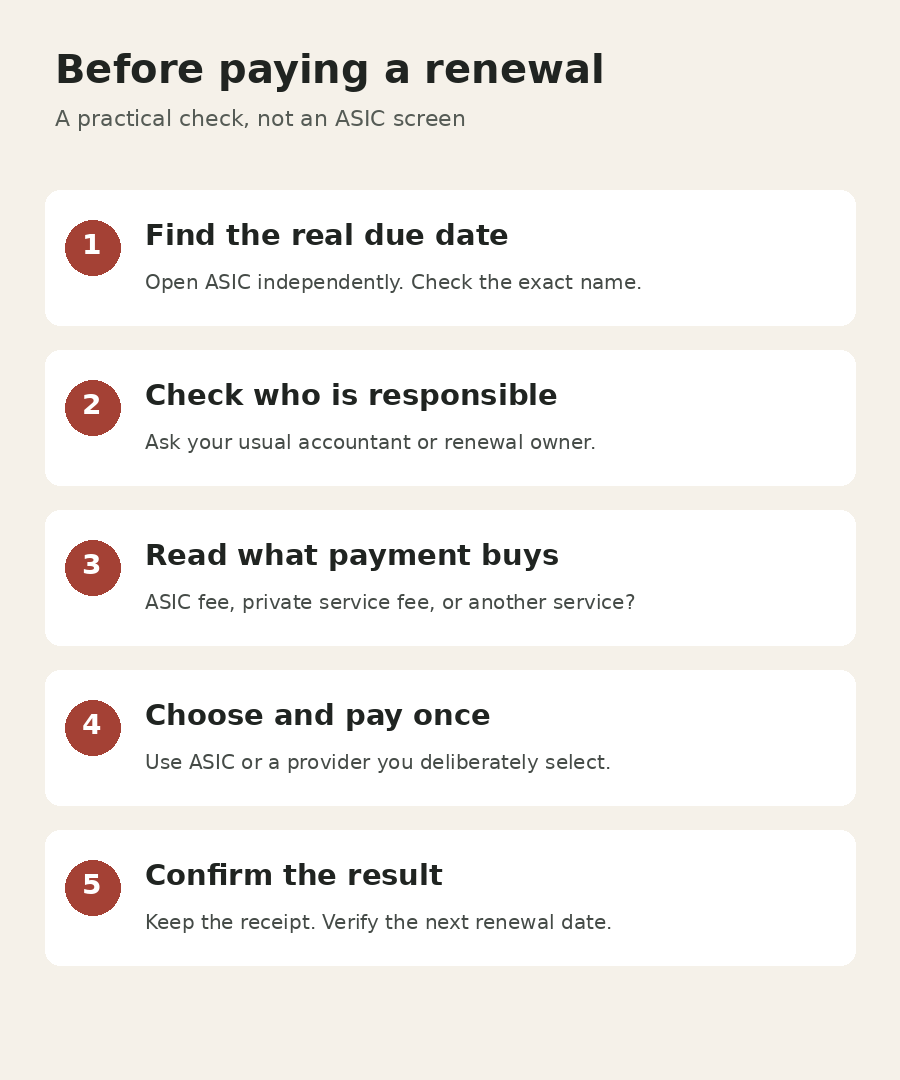
- Leave the notice alone for a moment. Do not use its payment button, QR code or phone number to authenticate it. Open ASIC’s website independently.
- Look up your business name. Use the ASIC business names register. Select “Business names index” in the search options. The free information includes the holder, ABN, status and next renewal date. Match the exact name, not a similar one.
- Check who normally handles it. If your accountant or an authorised staff member manages renewals, contact them using a saved, verified number. Avoid paying a second provider while the first is already handling it.
- Choose the route yourself. Follow ASIC’s business-name renewal guide. The “Business name renewal” service supports renewal using the account number or linked ABN, for one or three years. If you choose a third party, establish the total fee and exact service first.
- Verify the result. Keep the receipt and check the register’s next renewal date after payment has been received and processed. A provider’s receipt alone does not prove the ASIC registration has been renewed. If the date has not updated, clarify the status rather than automatically paying again.
ASIC says it sends a renewal notice at least 30 days before the due date, usually by email. That is helpful context, not a reason to trust every email or reject every letter. For prices, use the current ASIC business-name fee schedule. Any private handling fee is separate from the underlying ASIC fee.
Business name, company, ABN and domain are different
A business-name renewal is not a company annual review and it does not renew your website address. ASIC’s business-registration guidance explains these different registrations. Domains are not managed by ASIC. Our domain-renewal notice guide explains that separate check. An ABN is a separate business identifier; applying for an ABN is free.
Put the exact registration type on your payment checklist. A vague “business renewal” description is not enough to approve a payment.
Does fine print make it acceptable?
Do not assume there is a special loophole that makes a misleading invoice lawful. The ACCC says disclaimers must not conflict with the overall message. Whether a particular notice breaks the law depends on its contents and circumstances. An extra service fee by itself is not proof of fraud.
You do not need to decide the legal question before protecting your business. Pause the payment, establish what is due, and choose whether you actually want the service offered.
Already paid? Check the outcome before doing anything twice
If you bought a service you did not intend to buy: check the ASIC registration status, keep the notice, terms and receipt, and contact the verified provider in writing. Ask what work was completed and state the remedy you want. The ACCC explains how to raise a problem with a business and where to seek further consumer help. A refund is not guaranteed; the ACCC does not resolve individual disputes.
If you suspect fraud or exposed payment/login details: contact your bank or card provider promptly through its official channel, stop further payments and secure affected accounts. Follow ASIC’s business scam response guidance and report the incident. If you entered credentials, use the real service’s recovery process, not the original message. Scamwatch’s phishing guidance explains why independently reaching the service matters.
Make the next notice easier to handle
Keep a small renewal register with the registration type, responsible person, verified provider and actual due date. Require approval for a new supplier, not merely a familiar business name. Our unexpected renewal invoice checklist covers the broader payment checks, while verifying supplier bank-detail changes addresses a different payment risk.
If your team needs practice recognising invoice-style offers and phishing, Osmicro’s security awareness training can support that process. The goal is not to ignore renewals. It is to pay the right party for the service you actually chose, without missing the genuine deadline.
Sources rechecked 26 October 2026. General business-security guidance, not a determination of any individual dispute.