
A renewal notice arrives with your business name, your domain and a payment deadline. It looks like another bill to clear before the website goes down. But what, exactly, are you buying?
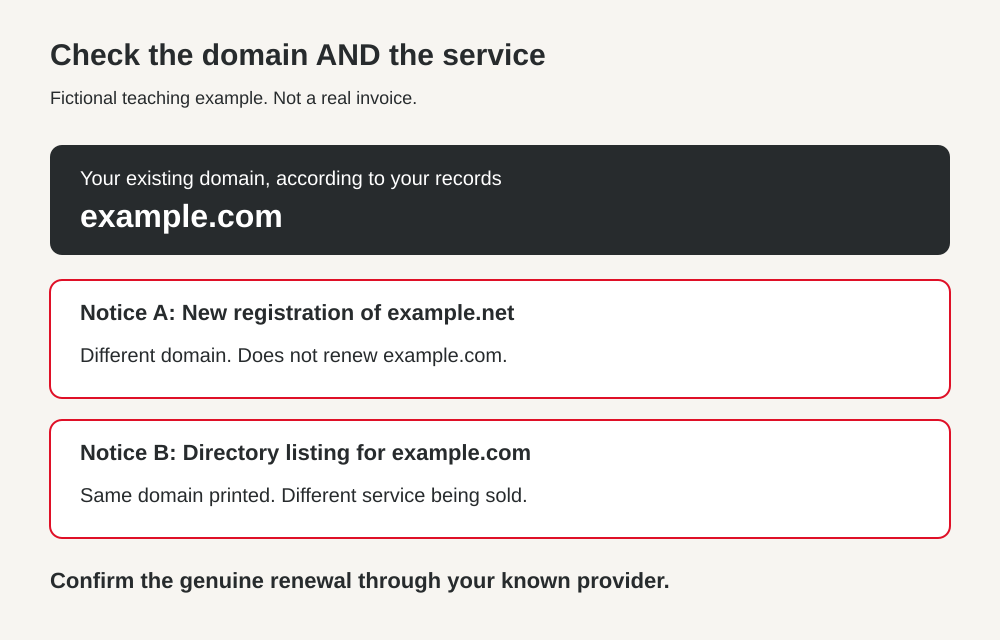
Some notices sell a directory listing. Others offer a different domain that resembles yours. Neither necessarily renews the address your website and email actually use. Paying the wrong notice can leave you out of pocket while your real renewal remains unpaid.
The safest rule: verify the exact domain, the service and the supplier through your existing provider before paying. A familiar domain printed on a document is not proof that the sender manages it.
Four different things that can look like a renewal
- A genuine renewal: extending the registration of the exact domain you already hold, through your registrar or authorised reseller.
- A new-domain offer: buying a different address, perhaps with a different ending or spelling. It may be a real product, but it does not renew your existing address.
- A directory or promotional listing: paying to have your business or web address listed somewhere. That is not domain registration.
- A transfer offer: moving management of a domain to another provider. Treat that as a deliberate provider change, not routine bill payment.
An unsolicited offer is not automatically a scam. The problem is when its presentation makes an optional purchase look like a bill you owe, or a renewal you must pay to keep your domain.
This is not a new Australian problem
Official warnings date back at least to January 2001, when the ACCC warned about domain renewal notices. That history supports a long-running pattern, not a claim that one business has operated unchanged for decades.
Real example 1: COM. AU. REGISTER, 2001–2002
What was being sold: an internet directory, not domain registration. The ACCC’s 5 April 2001 announcement of proceedings named COM. AU. REGISTER and described the service as a directory of business names and internet addresses.
What happened: on 8 March 2002, the ACCC reported Federal Court declarations by consent of fair-trading breaches. The outcome included corrective notices and undertakings about representations concerning registration and prior dealings.
Actual wording reproduced by the ACCC: “The registration of your Internet Address@reg.com.au is now due.” This is a short excerpt of the historical fax quoted in the 2001 proceedings announcement, not a recreated invoice.
The practical lesson: your domain appearing on a notice does not mean the payment registers or renews it. Read what the service actually is.
Real example 2: Domain Name Corp and Domain Name Agency, 2018
What was being sold: new domain names resembling recipients’ existing domains, rather than renewals of those existing domains. Domain Name Agency also traded as Domain Name Register.
What happened: the ACCC’s 15 June 2018 announcement reported combined Federal Court penalties of A$1.95 million. It said the businesses sent around 300,000 notices between November 2015 and April 2017 that appeared to be renewal invoices.
See a real notice: Aktura Technology’s 22 December 2015 article reproduces a Domain Name Corp letter. Its author points out that the offered address ends in .com rather than the client’s .com.au, and highlights “This is an invitation to register”. View the actual 2015 Domain Name Corp letter photographed and published by Aktura Technology, with recipient details obscured in its published copy. The photo is linked, not reproduced here; the legal outcome above comes from the ACCC, not the blog’s opinion.

The practical lesson: compare the complete address, including the ending. Paying for a similar new domain does not renew the one your business already uses.
Read the whole historical notice: layout, offer and payment instructions
Osmicro’s commentary: The full page matters because its parts work together. The official-looking heading and recipient block establish a formal business-letter appearance. The central offer gives a $249 price and two-year registration period, while the smaller terms identify an invitation rather than a bill. Payment options and a remittance-style reference-and-amount panel follow below. Read together, that sequence can invite routine accounts processing before the recipient checks what is actually being offered and whether they owe anything.
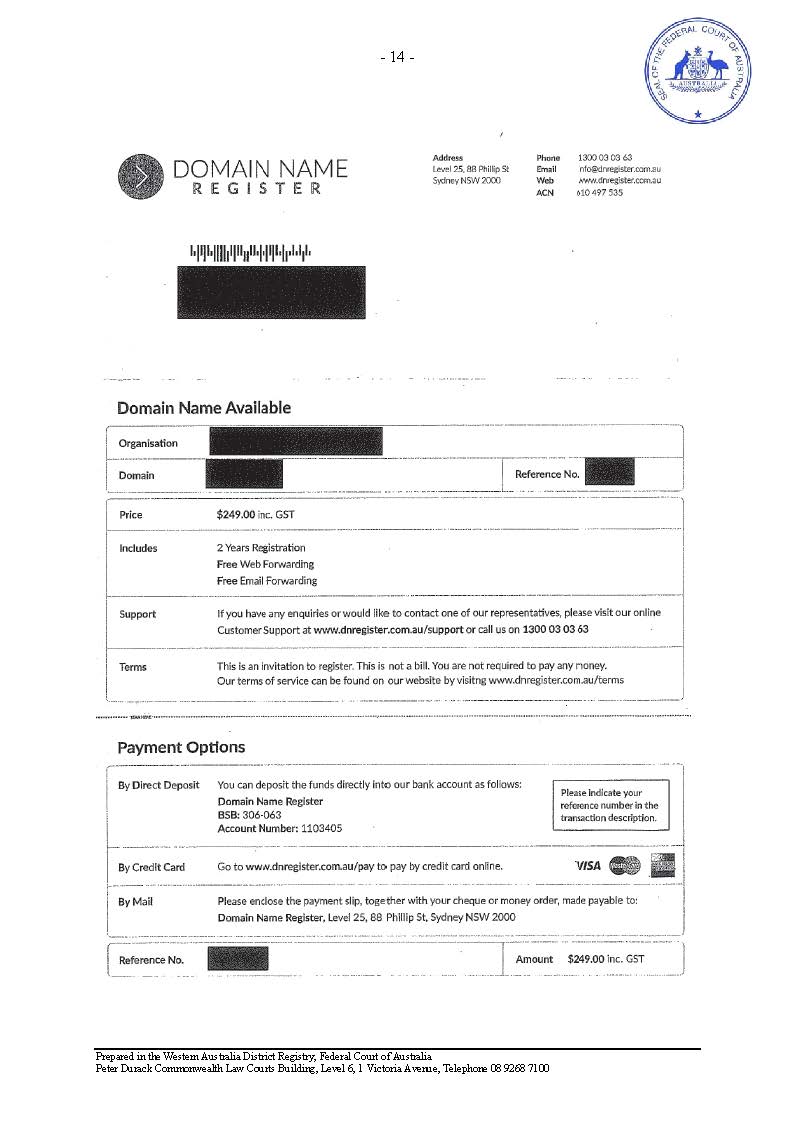
Osmicro’s commentary: The smaller terms say “This is not a bill. You are not required to pay any money.” Compare that qualification with the prominent price, registration period and payment machinery on the same page. The Court discussed invoice-like presentation and the de-emphasis of invitation wording at paragraphs 118–119. Seeing the complete document lets readers assess that contrast in context rather than relying on an isolated fragment.
This single exhibit is presented for criticism and review of its historical wording and layout. The notice was issued by Domain Name Register; the Federal Court hosts the annexure in the ACCC case. Osmicro’s commentary is separate from the Court’s judgment. Neither this reproduction nor the historical exhibit implies court endorsement or proves current conduct. The Court’s copyright statement reserves third-party rights; attribution is not a claim of an unrestricted licence.
These are real, dated regulator-reported cases, with links to the original public records. They are not allegations about any business’s current conduct, and similarly named businesses should not be assumed to be the same entity.
Does small print make it legal?
Not automatically. The ACCC’s guidance on false or misleading claims explains that the overall impression matters. A qualification does not necessarily fix a misleading headline or presentation.
There are also rules about demands for payment for unrequested products or services. But an offer for a future service, an unsolicited service already supplied and a renewal under an existing agreement are not interchangeable situations. A specific notice needs to be assessed on its facts.
So we would not call this a proven “legal loophole”. Nor does a company name, ABN or terms-and-conditions paragraph prove that a payment request is legitimate. For your accounts team, the immediate question is simpler: did we order this exact service, from this supplier, for this domain?
A five-minute check before you pay
- Compare every character of the domain. Use your records, not the notice. Check the name and its ending: .com, .com.au and .au are different addresses. Watch for added words and small spelling changes.
- Identify what the payment buys. Look for “listing”, “directory”, “promotion”, “new registration” or “transfer”. If the headline says renewal but the description sells something else, stop and clarify independently.
- Open your existing provider’s portal yourself. Use a saved bookmark or a known address. Check the domain, renewal date, current status and invoice there. Do not use the notice’s payment link, QR code or phone number to verify the notice itself.
- Confirm the supplier relationship. Check your previous invoices and contract. Your web agency or IT provider may legitimately be a reseller, so its name can differ from the registrar shown in a lookup. An unfamiliar sender needs checking, not automatic payment.
- Keep the genuine renewal on track. Rejecting a misleading notice does not renew your real domain. Record the actual due date and who is responsible for paying it.
For the broader accounts-payable process, use our unexpected renewal invoice checklist. If payment details have changed, follow our separate supplier bank-detail verification steps as well.
For .au domains, WHOIS will not tell you the expiry date
You can use auDA’s official domain lookup to help identify the registrar, then check with your existing provider. Start from auDA’s renewal guidance, rather than a lookup link supplied by an unknown sender.
There is an important limitation: auDA’s WHOIS policy says public .au WHOIS does not disclose expiry dates. It specifically explains the risk of unsolicited renewal notices confusing domain holders. Confirm expiry in your provider account or through a trusted contact instead. Advice that says “just check the expiry in WHOIS” is not reliable for .au.
Also, a reseller does not need to appear as an auDA-accredited registrar to be legitimate. auDA explains the difference between registrars and resellers. Use that distinction to check the chain of service, not to label every unfamiliar name a scam.
Already paid? Protect the money and the domain separately
- Contact your bank or card provider promptly. Explain the payment and ask what recovery or dispute options are available. Recovery is not guaranteed.
- Contact your real domain provider independently. Confirm whether the genuine renewal is still outstanding and whether any transfer or account change has occurred. Do not assume the other payment extended your domain.
- Keep evidence. Save the original notice, email headers, payment receipt, terms and any correspondence. Do not circulate passwords or transfer codes in a group email.
- If you supplied login details or a transfer code, tell your provider immediately. Use its official account-security and recovery process. An authorisation code can enable a domain transfer; it is not an ordinary invoice reference.
- Report the notice through official channels. Scamwatch’s domain-offer warning explains this pattern. Use Scamwatch to report suspected scams, your relevant consumer protection agency for a consumer dispute, and ReportCyber where cybercrime is involved.
Make the next notice easier to spot
Keep a small domain register: exact domain, registrar or reseller, trusted contact, portal address, genuine renewal date and the person responsible. Store access credentials separately in your approved password manager. Give accounts staff permission to pause an unfamiliar notice and check it with that person.
Do not share a domain password or transfer code to “confirm” an unsolicited invoice. If changing providers is genuinely intended, follow your verified provider’s transfer process. For Australian domains, follow auDA’s .au transfer guidance. For domains covered by ICANN’s transfer policy, ICANN explains the role of Auth-Codes.
Our cyber security awareness training can help staff practise these checks without needing to become domain experts. The aim is not to memorise a list of suspicious company names. It is to make sure the right service is renewed, through the right provider, before money leaves the business.
Sources checked 24 October 2026. General awareness information, not legal advice about a particular notice.